

Knowing how to help an anxious child go to school can feel impossible when every morning ends in tears, stomachaches, pleading, or panic. You may wonder whether to comfort your child, push harder, or let them stay home.
The answer is usually a balance. Children need empathy, structure, and a realistic plan that helps them experience school as manageable again.
Table of Contents
- Why children avoid school
- Find the source of school anxiety
- Create a calmer morning routine
- Partner with the school
- Use gradual exposure
- Know when to seek help
- Help your child return confidently
Why an Anxious Child May Avoid School
School avoidance, sometimes called school refusal, describes significant difficulty attending or remaining at school. It is not a DSM-5-TR diagnosis. Instead, it may be connected to separation anxiety, social anxiety, generalized anxiety, depression, trauma, bullying, learning difficulties, or other concerns.[1]
An anxious child may experience:
- Stomachaches, nausea, or headaches
- Dizziness, a racing heart, or trouble breathing
- Difficulty sleeping before school
- Crying, clinging, freezing, or anger
- Repeated requests to stay home or leave early
These symptoms are real, even when a medical examination does not find an illness. Anxiety activates the body’s alarm system, and children may not yet have the words to explain what feels threatening.[2]
Find the Source of Your Child’s School Anxiety
Avoid asking only, “Why don’t you want to go?” Many children genuinely do not know. Instead, use calm, specific questions:
- “Is the hardest part leaving me, entering school, or being in class?”
- “Are you worried about making a mistake?”
- “Does anyone make you feel unsafe or left out?”
- “Is the work confusing, difficult, or embarrassing?”
- “Are lunch, recess, bathrooms, noise, or transitions hard?”
Talk with the teacher, counselor, nurse, and other adults who see your child at school. A change in attendance may be connected to bullying, academic pressure, friendship problems, sensory overload, family stress, or an untreated mental health condition.[3]
Create a Calmer School-Morning Routine
Long negotiations give anxiety more time to grow. Make mornings predictable, warm, and low-drama.

For a calm school-morning routine, try:
- Preparing clothes, backpacks, and lunches the night before
- Keeping bedtime and wake-up time consistent
- Using a visual checklist
- Offering only two simple choices
- Practicing one coping skill before leaving
- Using the same brief goodbye each day
You might say, “I believe you that this feels hard, and I know you can do hard things. Your teacher will help you, and I will see you after school.”
Unless your child shows signs of a true medical problem, focus on the next step rather than repeatedly asking whether they feel well enough to attend. A pediatrician can help rule out physical causes when symptoms are new, persistent, or concerning.
Partner With the School for Anxiety Support
School refusal is rarely solved by one exhausted parent alone. Effective plans often involve the child, caregivers, school staff, pediatrician, and therapist.[4]
Ask about school anxiety supports such as:
- Meeting a trusted adult at arrival
- Entering through a quieter door
- A brief morning check-in
- A calm space with clear time limits
- Help with bullying, peer conflict, or learning needs
- A 504 Plan or IEP when appropriate
The goal is not to remove every uncomfortable feeling. It is to provide enough support for your child to stay engaged while building confidence.
If anxiety is disrupting attendance, learning, or family life, our child therapists can help uncover what is driving the distress and create a coordinated plan.
Ready for calmer school mornings?
Use Gradual Exposure for School Refusal
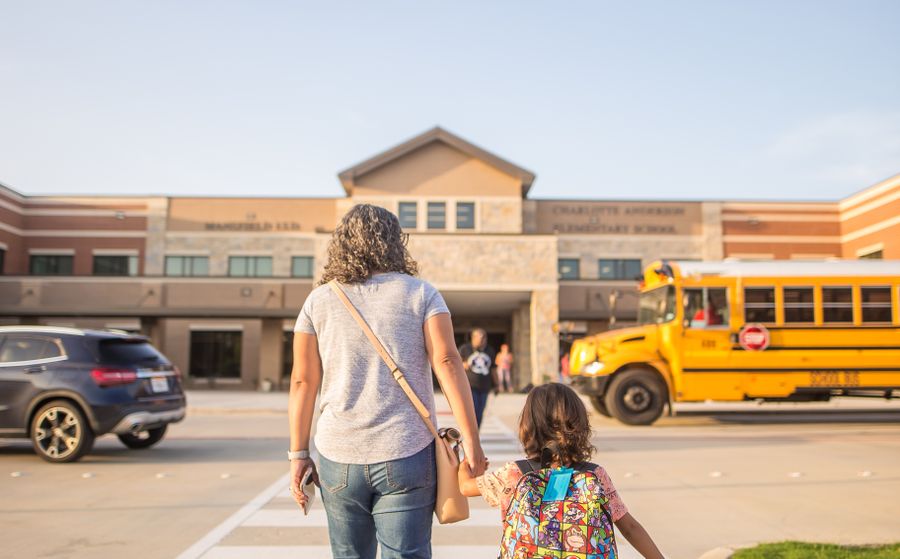
Avoidance brings immediate relief, which can unintentionally teach the brain that school was dangerous. Gradual exposure helps a child face feared situations in manageable steps.
A return plan to school might move from:
- Driving past the school
- Walking to the entrance after hours
- Meeting a trusted staff member
- Attending one class or part of the day
- Increasing attendance on a written schedule
- Returning to the full school day
Cognitive behavioral therapy, or CBT, often combines coping skills, flexible thinking, parent involvement, and gradual exposure. Research supports CBT and behavioral approaches for childhood anxiety and school refusal, although the plan should be individualized.[5]
The plan should keep moving forward. A reduced schedule can help temporarily, but repeating it indefinitely may strengthen avoidance. The child’s therapist, school team, and caregivers should agree on the steps and review progress regularly.
When an Anxious Child Needs Professional Help
Contact a pediatrician or child mental health professional when anxiety:
- Lasts more than a week or is worsening
- Causes repeated absences, tardiness, or early pickups
- Interferes with sleep, eating, friendships, or academics
- Includes panic attacks or frequent physical symptoms
- May be connected to bullying, trauma, depression, or learning problems
- Leaves your family feeling stuck
A comprehensive evaluation may include developmental and medical history, family observations, school information, and an assessment of emotional and behavioral symptoms.[6]
Seek urgent help if your child talks about suicide, self-harm, harming someone else, or being unsafe.
Ready for calmer school mornings?
How to Help an Anxious Child Go to School With Confidence
Learning how to help an anxious child go to school starts with recognizing that your child is not trying to ruin the morning. They are showing you that something feels bigger than their current coping skills.
Your job is to offer compassion without allowing anxiety to shrink their world. With consistent routines, school collaboration, gradual practice, and professional support, children can rebuild confidence and return to learning.
If school anxiety has taken over your family’s mornings, you do not have to solve it alone. Contact our team today to help your child feel safer, stronger, and more confident at school.
Footnotes
1.National Library of Medicine, “School Refusal.”
2.American Academy of Pediatrics, “School Avoidance: Tips for Concerned Parents.”
3.American Academy of Child and Adolescent Psychiatry, “School Refusal.”
4.National Institute of Mental Health, “Children and Mental Health: Is This Just a Stage?.”
5.Centers for Disease Control and Prevention, “Anxiety and Depression in Children”; Maynard et al., “Psychosocial Interventions for School Refusal With Primary and Secondary School Students.”
6.National Institute of Mental Health, “Children and Mental Health: Is This Just a Stage?.”
This version is approximately 950 words before the footnotes and is ready for formatting in WordPress.


0 Comments