
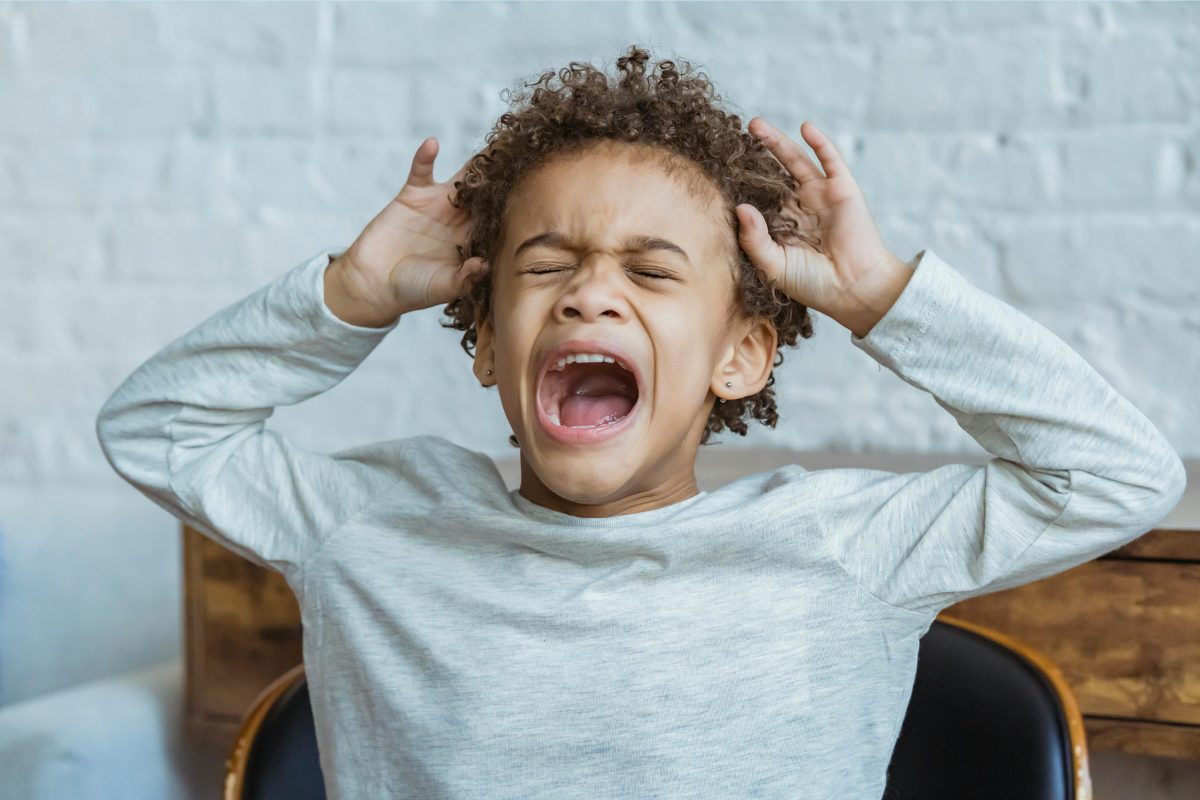
If you’ve ever wondered how to help my child with big emotions while your child is crying, yelling, melting down, shutting down, or spiraling over something that seems “small,” please know this: your child is not giving you a hard time just to make your life harder. They are often having a hard time.
Big emotions are a normal part of childhood development. Children are still building the brain-based skills needed to pause, name what they feel, tolerate frustration, and choose what to do next.1 Our job as parents is not to stop every big feeling. Our job is to become the safe, steady guide who helps our child learn what to do with those feelings.
Table of Contents
- Why Kids Have Big Emotions
- How to Help My Child With Big Emotions in the Moment
- Teach Emotional Regulation When Everyone Is Calm
- Set Loving Limits During Big Feelings
- When Big Emotions May Need Extra Support
- How to Help My Child With Big Emotions Starts With Connection
Why Kids Have Big Emotions
Children are not born knowing how to regulate their emotions. Emotional regulation requires language, attention, impulse control, problem-solving, and nervous system maturity.2
That means your child may genuinely know what the rule is and still struggle to follow it when they are overwhelmed.
Common triggers for big emotions include:
- Hunger or fatigue
- Transitions
- Sensory overload
- Feeling misunderstood
- Sibling conflict
- Disappointment or frustration
- Anxiety or fear
- Too many demands at once
When your child melts down, their thinking brain is not fully in charge. They are often operating from a more reactive, protective state. This is why long lectures, threats, or too many questions usually do not work in the heat of the moment.
Children learn emotional regulation through co-regulation first. That means they borrow our calm before they can consistently access their own.
Related Reading: Common Anxiety Signs for Kids Age 5-7
When Big Emotions Are Tied to Sensory Needs, ADHD, or High Sensitivity
Some children feel everything more intensely. That’s not a flaw — it’s just how their nervous system is wired.
If your child seems to melt down faster than other kids, recover more slowly, or get completely overwhelmed by transitions, noise, clothing textures, or unexpected changes, there may be more going on beneath the surface. Children with ADHD, sensory processing differences, or traits of a highly sensitive child (HSC) often have a lower regulatory threshold — meaning their nervous systems hit overload faster and need more support to come back down.
Here’s what that can look like:
- Meltdowns that seem disproportionate to the trigger
- Physical complaints before or during emotional overwhelm (stomachaches, headaches)
- Extreme reactions to clothing, food textures, or sounds
- Difficulty transitioning between activities, even ones they enjoy
- Big emotional reactions that linger much longer than expected
This doesn’t mean something is “wrong” with your child. It means their brain and body need a more tailored approach to co-regulation and coping — and they often respond beautifully to the right support.
If you’ve tried the usual strategies and you’re still not seeing improvement, that’s information. It might be time to get a professional opinion. Our therapists at The Peaceful Mind Counseling Center are experienced in working with children whose emotional intensity is connected to neurodevelopmental differences, sensory needs, or high sensitivity. Reach out to schedule a free child therapy consultation.
How to Help My Child With Big Emotions in the Moment
When parents ask, “How do I help my child with big emotions right now?” the most important first step is safety and regulation.
Before you teach, correct, or problem-solve, help your child’s nervous system settle.
Try this simple order:
- Pause and lower your voice. Your calm presence communicates safety.
- Get physically low. Kneel or sit nearby so you feel less threatening.
- Name what you see. “You are so mad that it was time to leave.”
- Validate the feeling. “It makes sense that stopping something fun feels hard.”
- Reduce words. A dysregulated child cannot process a speech.
- Offer one simple support. “I’m here. You can breathe with me or sit next to me.”
Validation does not mean you agree with the behavior. It means you are helping your child feel understood so their brain can begin to calm.
For example, instead of saying:
- “Stop crying. It’s not a big deal.”
Try:
- “This feels really big to you. I’m right here. We’ll figure it out together.”
The American Academy of Pediatrics reminds parents that intense feelings are normal, and children need adults to help them develop coping skills over time.3 That phrase “over time” matters. Emotional regulation is not learned in one magical parenting moment. It is built through repeated experiences of connection, structure, repair, and practice.
Teach Emotional Regulation When Everyone Is Calm
The middle of a meltdown is not the best time to teach a new skill. Instead, it’s the time to co-regulate.
The teaching happens later, when your child’s brain is back online.
You might say:
- “Earlier, your body got really angry when screen time ended. Let’s practice what you can do next time.”
- “It is okay to feel mad. It is not okay to hit.”
- “Your feelings got so big that your words disappeared. Let’s make a plan for next time.”
Helpful emotional regulation tools include:
- A feelings chart
- A calm-down corner
- Deep breathing games
- Physically letting the emotions out: Squeezing a pillow, “shaking it off”, running, jumping jacks, etc.
- Drawing the feeling
- Asking for a break
- Naming body clues like tight fists, hot cheeks, or a fast heartbeat
- Practicing scripts like, “I’m mad. I need help.”
The CDC describes children’s mental health as including emotional milestones, healthy social skills, and learning how to cope when problems arise.4 In other words, coping is a skill, not a personality trait.
Some kids need more repetition than others, and that’s ok. It means their brain and body need more support, more structure, and more practice.
Ready to take the next steps in your mental health journey?
Set Loving Limits During Big Feelings
One of the most important parts of learning how to help your child with big emotions is understanding that connection and boundaries belong together.
Your child is allowed to feel angry. They are not allowed to hurt people.
Your child is allowed to feel disappointed. They are not allowed to destroy property.
Your child is allowed to cry. They are not allowed to be cruel.
A helpful limit sounds like:
- “I won’t let you hit me.”
- “You can be mad. The tablet is still done.”
- “I hear that you want the toy. I’m not buying it today.”
- “I’m going to move your brother to keep everyone safe.”
- “You can yell into this pillow, but you may not scream in my face.”
The goal is not to punish the emotion. The goal is to protect safety while teaching your child that feelings are manageable.
Healthy limits help children feel more secure. When parents stay steady, children learn, “My feelings can be big, and my grown-up can still handle me.”
That is deeply regulating for a child.
When Big Emotions May Need Extra Support
Big emotions are normal, especially in toddlers and young children. Tantrums are particularly common between ages 1 and 3, when children are still developing language and frustration tolerance.5
However, sometimes emotional outbursts may signal that a child needs additional support.
Consider reaching out to a pediatrician or mental health professional if your child’s big emotions are:
- Very frequent or intense
- Lasting much longer than expected for their age
- Creating problems at home, school, or with peers
- Paired with aggression, self-harm, or threats of harm
- Connected to trauma, grief, major life changes, or anxiety
- Not improving with consistent support and structure
The DSM-5 includes Disruptive Mood Dysregulation Disorder, or DMDD, for children with severe, recurrent temper outbursts and persistent irritability that go beyond typical tantrums.6 This does not mean every emotionally intense child has a diagnosis. It simply means that if the intensity feels extreme, persistent, or impairing, you don’t have to figure it out alone.
Therapy can help children learn emotional awareness, coping skills, problem-solving, and safer ways to express distress. It can also help parents feel more confident and less reactive during hard moments.
If your family is feeling overwhelmed by your child’s emotional ups and downs, support can make a meaningful difference. Contact us today to take the first step toward more peace, connection, and confidence at home.
If your child’s big emotions are connected to a family change like divorce, you may also find it helpful to read our guide on how to talk to kids about divorce by age.
Ready to take the next steps in your mental health journey?
What Child Therapy for Big Emotions Actually Looks Like
A lot of parents ask us: “What actually happens in a therapy session for a young child?”
It’s a great question — and a really common reason families wait longer than they need to.
Here’s what you can expect when you bring your child to The Peaceful Mind Counseling Center.
The first appointment is about your family, not just your child. We start by learning from you — what’s happening at home, when the big emotions show up, what you’ve already tried, and what feels most overwhelming. You’re an essential part of this process, and we treat you that way.
Sessions for younger children often look a lot like play. We meet kids where they are. Younger children especially process their experiences through play, movement, and creative expression. That’s not a workaround — it’s evidence-based. It’s how children learn to identify and manage their feelings when abstract conversation isn’t yet accessible to them.
Parents aren’t left out of the room. Depending on your child’s age and needs, we often work with parents directly — coaching you through co-regulation strategies, helping you understand your child’s triggers, and building a toolkit you can use at home. Real change happens in the space between sessions, and we want you equipped for that.
You don’t need a diagnosis to start. If your child is struggling and it’s affecting your family, that’s enough reason to reach out. We’ll help you figure out what’s going on and what kind of support makes the most sense.
How to Help My Child With Big Emotions Starts With Connection
Learning how to help your child with big emotions begins with a mindset shift: your child’s emotions are not the enemy.
Big feelings are communication. They tell us that a child is overwhelmed, under-skilled, tired, scared, frustrated, or needing support.
When we respond with calm, connection, and clear boundaries, we teach our children:
- Feelings are safe to talk about.
- Big emotions do not have to become unsafe behaviors.
- I can calm down with help.
- I can repair after hard moments.
- My parent(s) can love me and still hold limits.
And please remember, you will not do this perfectly every time. No parent does.
What matters most is the pattern. Calm when you can. Repair when you need to. Keep showing your child that emotions can be understood, supported, and managed.
If you’re ready for support in helping your child navigate big emotions, our team is here to help. Reach out today to begin building more emotional safety, stronger coping skills, and a calmer home for your family.
Ready to take the next steps in your mental health journey?
Footnotes
- American Psychological Association, “How to help kids understand and manage their emotions.” (American Psychological Association)
- American Psychological Association, “How to help kids understand and manage their emotions.” (American Psychological Association)
- American Academy of Pediatrics, “Handling Big Emotions.” (AAP)
- Centers for Disease Control and Prevention, “About Children’s Mental Health.” (CDC)
- HealthyChildren.org from the American Academy of Pediatrics, “Top Tips for Surviving Tantrums.” (HealthyChildren.org)
- American Psychiatric Association, DSM-5 overview of Disruptive Mood Dysregulation Disorder. (psychiatry.org)
Frequently Asked Questions About Children and Big Emotions
Is it normal for my child to have such big emotions?
Yes — and you’re not doing anything wrong. Children’s brains are still developing the circuitry needed to manage intense feelings. The prefrontal cortex, the part of the brain responsible for emotional regulation, impulse control, and rational thinking, isn’t fully developed until the mid-twenties. That means your child is not choosing to fall apart. They genuinely don’t have the tools yet. Big emotions in childhood are developmentally normal. Your job is not to eliminate them — it’s to help your child learn what to do with them. That’s the work.
At what age should a child be able to control their emotions?
Emotional regulation develops gradually and looks different at every stage. Here’s a rough roadmap:
- Ages 1–3: Meltdowns and tantrums are expected. Children at this stage have almost no self-regulation capacity. They depend entirely on a caregiver to co-regulate.
- Ages 4–6: Children begin to name feelings and use simple coping strategies, but will still need significant adult support during big moments.
- Ages 7–10: Most children can use language, deep breathing, or asking for help as first-line strategies — though they’ll still need co-regulation under stress.
- Ages 11+: Tweens and teens can use more sophisticated strategies, but emotional intensity often increases again with puberty.
If your child seems significantly behind these benchmarks — especially if big emotions are affecting school, friendships, or daily life — that’s worth exploring with a professional.
What is co-regulation, and why does it matter?
Co-regulation is the process of helping your child calm their nervous system by offering them yours. Children literally borrow our calm before they can consistently access their own. When you get physically low, lower your voice, and stay present without lecturing, your nervous system communicates safety to theirs. Over time — through many, many of these moments — children build the internal capacity to regulate on their own. Co-regulation isn’t about never getting frustrated. It’s about coming back to steady and letting your child borrow that steadiness.
When should I be concerned about my child’s emotional outbursts?
Intense emotions are normal. What you’re watching for is a pattern that goes beyond typical development — outbursts that are very frequent, very long, very intense, or that are interfering with your child’s ability to function at home or school. Also pay attention if your child’s big emotions are paired with aggression, self-harm, or withdrawal, or if things are not improving with consistent support. If you’re reading this because something feels off, trust that instinct. You know your child. And getting an outside perspective sooner rather than later is almost always better than waiting.
Can therapy really help with emotional regulation in kids?
Yes. Children’s brains are incredibly responsive to the right support, especially early on. Therapy helps children build emotional vocabulary, identify their physical cues before they escalate, practice coping skills in a safe environment, and repair after hard moments. It also helps parents feel more confident and less reactive — which changes the whole dynamic at home. Most families start to notice shifts within a few months of consistent work. Change and healing are possible. For your child, and for your whole family.


0 Comments